Valitse kieli:
Select Language:
Välj språket:


7.3 Pedestrian crossing regulations

A pedestrian crossing is a passage marked by traffic signs or road markings. It can be used by pedestrians, and sometimes also by cyclists, for crossing a roadway, a cycle road or a tramway.

When approaching a pedestrian crossing with a vehicle, you must exercise particular caution and drive at a speed enabling you to stop, if necessary, in front of the crossing. Pedestrians who are already crossing the street or about to do so must be allowed to go first.

Vehicle turning in an intersection must give way to a pedestrian, a bicycle or a moped crossing the intersecting road.
Also in other place than an intersection a vehicle that intends to exit the roadway or otherwise cross it has to give way to a pedestrian, a bicycle or a moped using the edge of the road.

The cyclists must give way. Notice the position of the traffic sign. If the cyclist is walking with the bike, he is considered to be a pedestrian and the driver must give way.
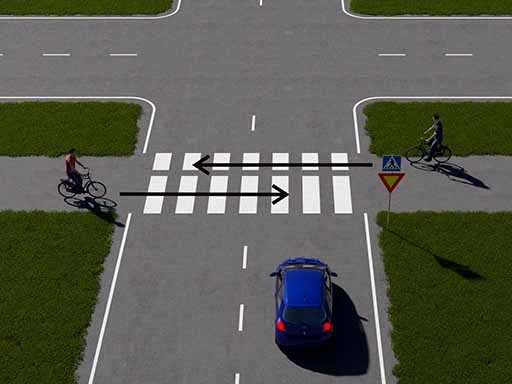
Driver has to give way to the cyclists. Notice the position of the traffic sign.
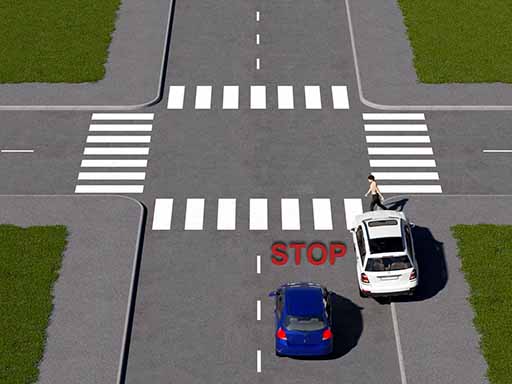
If a vehicle or tram stops in front of a pedestrian crossing, it may not be overtaken without stopping, unless there is a traffic island or empty lane between the stationary vehicle and your own.
If visibility with regard to a crossing pedestrian is otherwise limited, you must slow down and, if necessary, stop before the crossing.
Trams have to be overtaken on the right. A tram may, however, be overtaken on the left if the position of the rails requires this. Trams may also be overtaken on the left in the case of a one-way street. When intending to overtake a bus or tram from the right at an unelevated stop the driver has to stop and give way to passengers getting on or off the vehicle.