Valitse kieli:
Select Language:
Välj språket:


8.2 Signs guiding driving lines

The driver can change lanes or otherwise move sideways only when it can be done safely and without hindering other drivers needlessly.
You are not permitted to change lanes in an area where there is a solid white line to separate a turn lane from through traffic.
Use of a bus lane when driving straight
It is not allowed to use a bus lane when driving straight.
Driving line to the right
If the intersecting carriageway has two or more lanes, you can exit the junction using a suitable lane while observing any other traffic.
Use of a bus lane when turning right
Bus lane can be used by other traffic for turning right from an intersection.
One-way road when turning left
On a one-way carriageway, vehicles turning left must move to the left hand side of the lane and turn off the one-way carriageway from the left-hand side.
If the intersecting carriageway has two or more lanes, you can exit the junction using a suitable lane while observing any other traffic.
Parallel lanes when turning
Turning vehicle should not endanger or unnecessarily block other traffic that is moving to the same direction.
Traffic circle
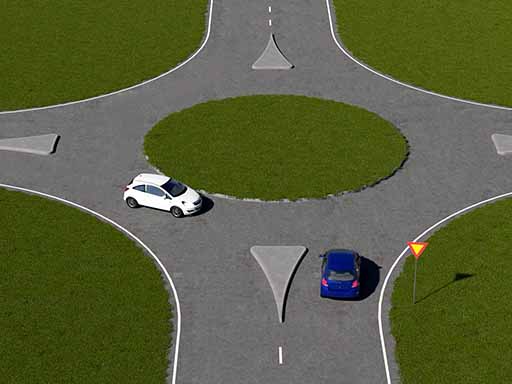
In a traffic circle (roundabout) traffic circulates counterclockwise. Indicators are not used when entering a traffic circle. Before exiting a traffic circle, you need to use the indicator to indicate where you intend to leave the traffic circle.

Two-way traffic: the sign warns that the one-way roadway is about to change to a two-way road.

Dangerous shoulders: the sign can be used to warn about elevated or fragile road shoulder.

Direction to be followed: the sign is used to signal the compulsory driving direction in an intersection.

Divider of traffic: the sign must be passed from the side that it indicates.

One-way road

Information of traffic lanes: the sign is used to indicate unusual organization of traffic lanes.